

WPBL Takes Adaptability to the Next Level

SPRINGFIELD, Ill. — With just 15 active players for each team on game day in the inaugural season of the Women’s Pro Baseball League, the position listed next to each player’s name is often merely a suggestion. It’s really just one option.
Fans can witness a player slotting in at several positions — even one they may not have played before — on any given day. This is partly because of necessity, partly because of the players' seemingly limitless athleticism and partly because their trailblazing baseball and softball careers have required them to become flexible multi-position players.
It’s a unique facet of the WPBL that puts the Los Angeles Dodgers’ use of two-way pitcher/slugger Shohei Ohtani and their philosophy of moving players around the diamond to shame. It may be a rarity in the MLB, but in the WPBL, only playing one position is on the unusual side.
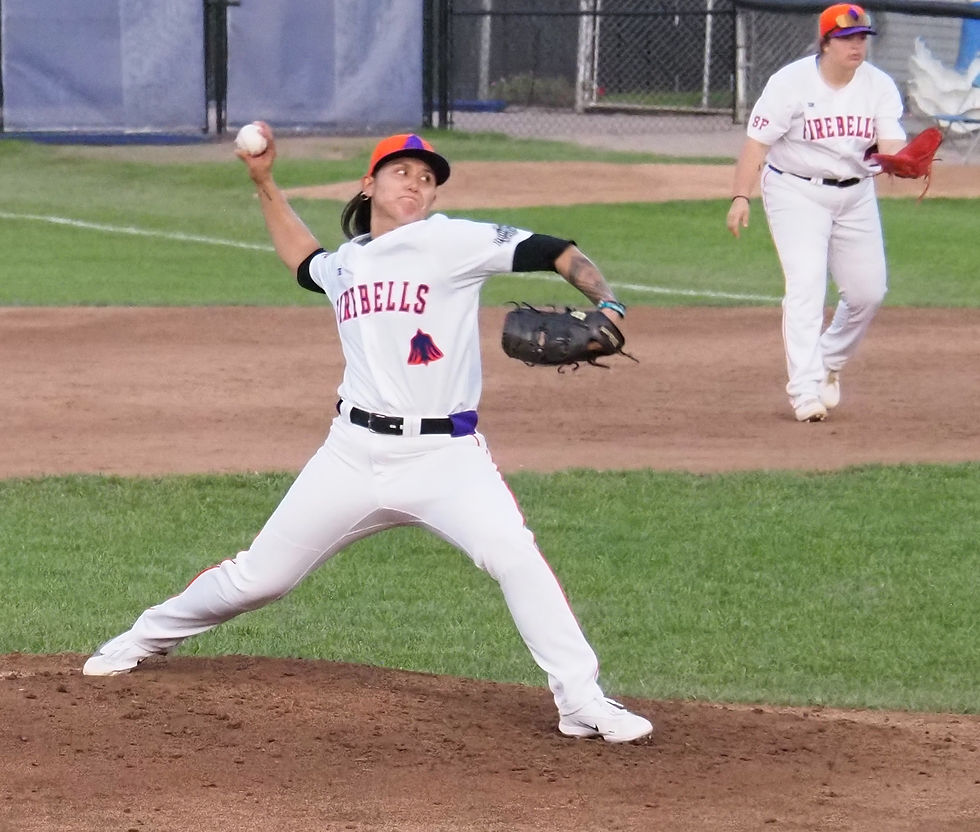
Just take Kelsie Whitmore for example. The No. 1 pick in the WPBL Draft, she’s near the top of the pitching and batting stat leaders lists. The San Francisco Firebells RHP/CF finished the regular season as league runner-up in innings pitched at 24, and happened to go 3-1 in six starts with a 5.25 ERA and 15 strikeouts (fourth most). At the plate, she smashed 11 homers, hit .451/.531/1.137 with a 1.669 OPS with 31 RBIs and 21 runs scored in 51 at-bats.

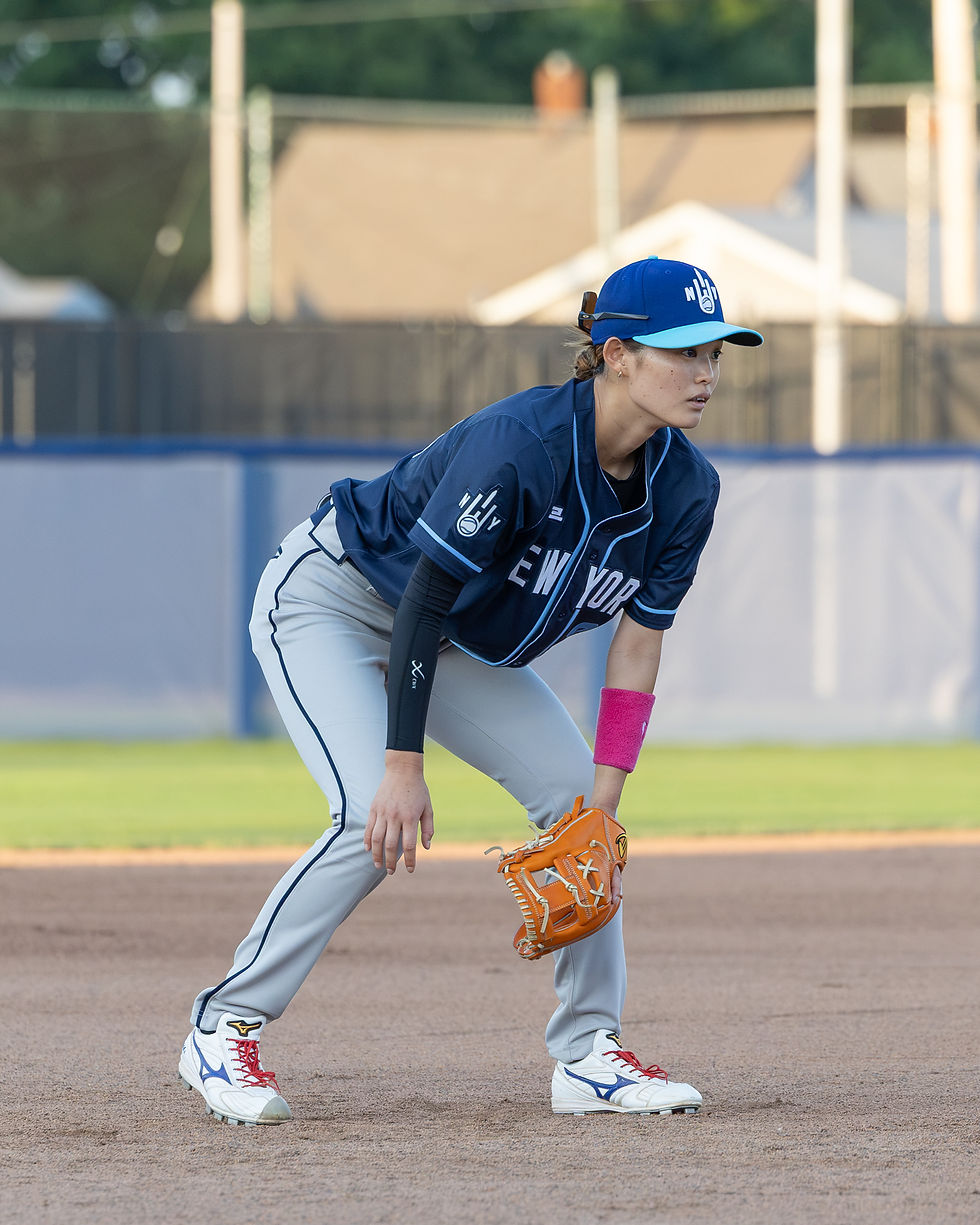
Emi Saiki, who has built an accomplished career for herself in Japan, is a top-notch shortstop, but can also pitch. The New York Heights star hit .667/.765/.667 with a 1.431 OPS, five walks, five RBIs, four runs scored and one stolen base in 17 plate appearances over six regular season games. She also went 1-0 in two starts with a 4.45 ERA and seven strikeouts in 11 innings pitched. And she did all that despite missing the first half of the season due to an issue with her visa.

San Francisco’s Andréanne Leblanc is a power switch-hitting first baseman who can also pitch, as Firebells manager Matt Williams recently learned when his roster was running thin. She’s now thrown two scoreless innings in two appearances, in addition to hitting .365/.484/.538 with an 1.023 OPS on top of two homers and 13 RBI.
While players like Whitmore, Saiki and Leblanc entered the WPBL with vast experience at multiple positions, others are eager to try out new ones. Wanting to help their teams and play as much as possible in this historic first season, most players have the same attitude as Los Angeles Queens RHP/outfielder Michelle Roche.
“I love being on the field, on the bench, on the mound. I think it’s all great,” Roche said.

Learning on the fly on the field
The willingness to play anywhere is a double-edged sword for managers, who face an extra challenge in filling out lineups for each game because there are so many decisions to make. At the same time, there are more possibilities, which helps a manager like L.A.’s Eric Young Sr. Young has an impressive MLB playing and coaching career that spans decades, but the WPBL job is his first managing job.
“I have players who say, ‘Skip, just put me in. I can play here, I can play there, I can play anywhere,’” Young said. “I said, ‘Are you just telling me that? Look, I'll get you one try at it, but can you back it?’”
Young is finding out that the answer, more often than not, is yes.
It’s worked for Sarah Edwards, an accomplished first baseman, who volunteered to play in the outfield. She joined outfielding newbies like Roche and Ashton Lansdell, a third baseman with a wide range and an arm more than capable of cross-diamond throws.
“You take my captain, Ashton. She said, ‘Skip, I know you need some help in the outfield. I can play right field.’ I said, ‘What?’ I never even thought about it,” Young said. “Because I want to get Caitlin [Eynon] to play third. Because I had [Samaria] Benítez and Amira [Hondras] and [Ayuri] Shimano all trying to get into the infield. So I'm trying to move things around and find the best fit.”
Prior to Lansdell’s right field debut on Aug. 26 against the Boston Hunters, Young hit her some fly balls during batting practice and also stood with her in right field to talk about fielding the position. It worked pretty well as Lansdell played it cleanly, making catches and hitting the cutoff woman. She was even a fraction of a second from getting an outfield assist when she nearly gunned down a runner at first on a hard-hit single right to her.

Lansdell was back at third base on Aug. 27, where she finished fourth in the WPBL with 28 assists this season.
“I felt more at home today,” Lansdell said after the 12-4 loss to the Heights. “It was nice to be back at the hot corner, but whatever puts my team in the best position to win. Third base, right field, whatever it is, I am happy to do it.”

Boston manager Jemile Weeks has also demonstrated his flexibility this season. He spent the preseason and first eight days of the regular season as an assistant coach under Young for the Queens. When Hunters manager Keith Foulke was dismissed on Aug. 9, Weeks took the job. A self-described “developer by trade,” Weeks didn’t get to have a preseason with his players and had to learn what they are capable of as he went. Toward the end of August, he was starting to see how versatile his team could be.
“In the last few days, I have been kind of shaking things up,” Weeks said. “You realize the skill sets in every area that they have.”
Proof of that is Canadian Women’s National Baseball team pitcher Alli Schroder, who logged the second-most innings pitched for Boston in the regular season at 14.2. In a game against the Queens on Aug. 26, she volunteered to play first base. She learned where to stand — and where not to stand — the hard way when she inched back to catch a low throw to try to retire Eynon, who hit a grounder in the first inning. Enyon collided with Schroder, knocking both players to the ground as Eynon was called safe.
Both players were ok, and Schroder didn’t let it affect her. She bounced back to hit an RBI single that temporarily put the Hunters up 6-5 in the fifth inning. She also returned to the mound in relief in the sixth inning with the bases loaded and no outs. Despite the tough spot, Schroder struck out two Queens and only gave up two runs on a single and wild pitch.

Weeks was impressed with the performance.
“She was hungry. She hit the ball well tonight. She played pretty good at first base, in my opinion, minus that one thing that happened with going back instead of forward to catch that ball,” Weeks said. “But again, that's just experience of being on the field. And then she pitched and actually did a great job with that too. I'm proud of that. If she brings it like that, she should continue to get opportunities.”
Adapting on and off the field
Considering that the first season of the WPBL only goes from Aug. 1 through playoffs in mid-September, the players have other sources of income and outlets to play throughout the year. Some have part-time jobs, perhaps at a coffee shop or restaurant, to supplement their often meager baseball incomes. Some players are coaches at various levels of baseball and softball. Some played softball and now play baseball and some are doing both simultaneously.
Queens catcher Maggie Foxx is playing in the WPBL in the summer between her sophomore and junior years of playing softball at Brown University. Until Aug. 8, Boston outfielder Lexi Hastings was playing in the Professional Softball League for the Kansas City Diamonds. Having only played three baseball games in her life before joining the WPBL, she’s now set on playing both baseball and softball. Los Angeles utility player Addisyn Baird is still in high school in Indiana, where she also plays hockey.
Off the field, the WPBL is full of impressive resumes. Boston’s Beth Greenwood is the director of baseball development for Baseball for All, the largest girls’ baseball organization in the United States. It was founded by WPBL commissioner Justine Siegal. Her Hunter teammate Ticara Geldenhuis is a strength and conditioning coach who did an internship with MLB’s Arizona Diamondbacks and works with rugby teams in Australia. Los Angeles’ pitcher Meggie Meidlinger is nicknamed “The Architect” for her precision planning on pitch location, but also because she is a sports facilities architect when she’s not playing baseball.

Four WPBL players have been or are currently first responders. Three of them are on the Heights. Catcher Denae Benites is a volunteer firefighter and EMT in Delaware. First baseman London Studer is in a police cadet training program in Ohio. Infielder Val Perez is a recently retired firefighter who is taking a break from her current job as the head coach for the Firefighters in the Banana Ball league. She thought her playing days were done, but her wife talked her into playing in the WPBL and not wasting the historic opportunity — despite also juggling mom duties for her three young children.

A wildland firefighter in Canada, Schroder completes the WPBL first responder team. On Friday, Aug. 28, the WPBL honored first responders on the field and in the stands, taking a moment to give EMTs, paramedics, firefighters, and police in attendance a standing ovation.
The contest also happened to feature a limited edition Alli Schroder bobblehead giveaway handed out to the first 250 fans. People lined up outside Robin Roberts Stadium in Springfield, Ill. two hours before first pitch in hopes of getting one.

Lansdell picked up a new job while playing in the WPBL: a podcaster. She is the host of the official WPBL Podcast, which features weekly conversations with players, coaches, and league staff. It gives a behind-the-scenes look into the biographies of players and life off the field. The episodes are on Spotify and YouTube where the WPBL has 45,000 subscribers. With 25 episodes, several of which have a couple thousand views and lots of positive feedback, it’s doing quite well, despite Lansdell saying that she didn’t listen to podcasts very often before taking on this role.
“It’s honestly great. It’s a lot more impactful than I had expected it to be. I have fans every single day come up to me that they love the podcast and they listen to every episode. I didn’t think it would become this whole thing,” Lansdell said. “It’s cool to see people listening and paying attention to us and wanting to learn about the league. The podcast just provides another outlet for more information to be provided to the public about women’s baseball and about the WPBL.”
Lansdell is always on the search for the next guest. Even during a game against the Heights, She struck up a conversation with New York manager Rocky Henley, who also serves as the third base coach for her squad. As the inning ended, Lansdell and Henley were discussing when they could schedule a time for Henley, a women’s baseball pioneer, to come on the pod. That episode came out on Sept. 11.
Just as the world is learning about the complex lives and playing profiles of each WPBL player, so is Lansdell.
“I have gotten to know a lot of people that I have already known, but I got to know them more and I found out things I never would have found out without that one podcast episode,” Lansdell said. “So it’s been fun.”


Comments